Gov. Kotek is statutorily required to release her 2027-2029 biennial budget on December 1st.
Much has been made of the $420 million budget shortfall facing Oregon lawmakers, with particular attention on the funding shortages coming to Oregon Medicaid.
So, I took a look at the budget that OHA prepared for the governor to review to see what the governor would be weighing in terms of decisions.
The document — all 2,963 pages of it — is titled “Oregon Health Authority 2027-29 Agency Request Budget” and serves as something of a “wish list” of program investments that the governor will have to balance against other agency requests in preparing her budget.
It also includes proposed cuts of 10% of the current agency budget, which while included in the OHA’s submission, is something the agency is required to produce rather than a list of proposed cuts the OHA is advocating for.
However, because so much of the health care budget is funded with federal dollars, the ROI on investments made in health care tend to be higher due to federal matching funds than other agencies. From the introductory letter signed by Interim OHA Director Fariborz Pakseresht.
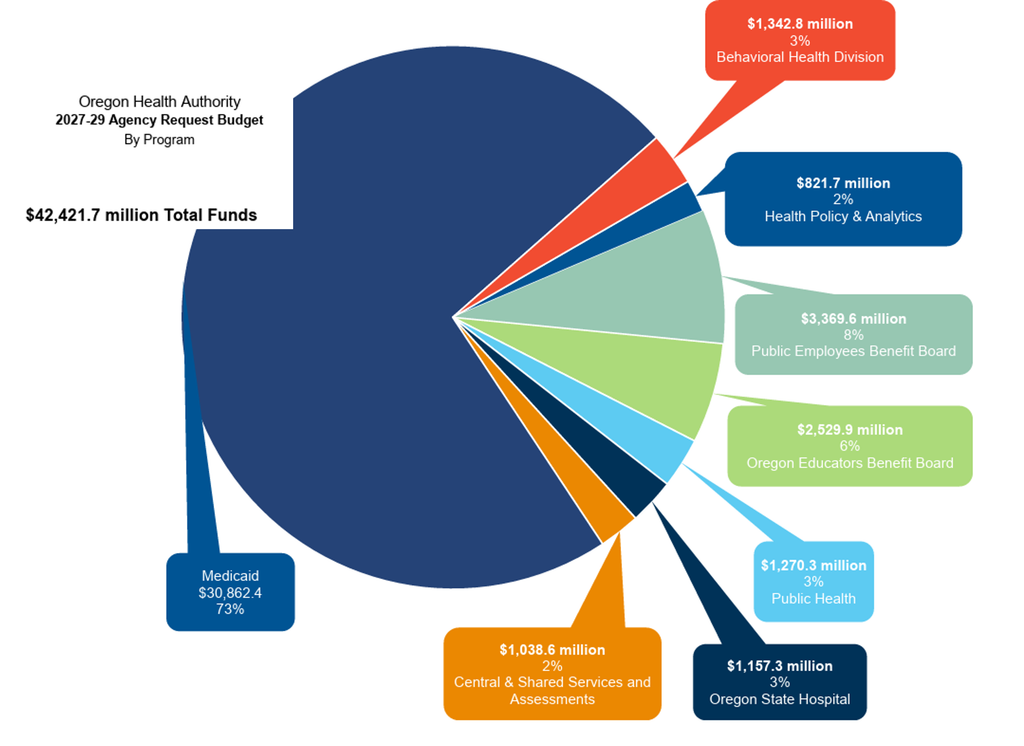
OHA’s 2027-2029 budget for the biennium request is $42.3 billion in total funds ($7.4 billion in state general funds).
This represents growth over the previous biennial total funds budget of about 1.9%, as outlined in the Agency Summary Narrative.
Oregon Health Authority’s (OHA) 2027-29 Agency Request Budget (ARB) represents a $1.0 billion General Funds/ $0.8 billion Total Funds increase over its 2025-27 Legislatively Approved Budget (LAB).
The budget submitted comes with 26 “Policy Option Packages” (POPs) for consideration. These POPs become the “asks” that an agency can submit above the baseline budget, or “floor.”
The governor can still cut into the baseline budget, but typically — particularly in health care — a lot of those funds are federally mandated funds, like the federal matching funds (FMAP) for Medicaid. So, they can’t be cut easily.
Here are a few of the interesting POPs submitted by OHA, as well as some of the cuts they’ve identified for the governor’s consideration.
HCMO reform is a topic that is likely to get a hearing in the legislature. It was the subject of the Health System Sustainability Group over the summer, and House Democrats are working on HCMO reform language.
A complaint about HCMO’s process is that it takes too long and costs too much money. This POP appears to want to mitigate that by adding new funds to the program. It adds 4 FTEs and $2.6 million in funding to support legal fees and community engagement efforts.
However, market actors may not exactly love the agency’s rationale for the funding.
“This POP requests funds to cover HCMO program costs that are not covered by fee revenue, including staff, DOJ attorney costs, and required community engagement efforts. Without this policy package to support the HCMO program, health care in Oregon could become more consolidated, resulting in higher prices without improved quality, and reduced access to care, particularly for low-income communities, rural communities, and communities of color.”
This is the third straight biennium OHA has made this request. HCMO could raise its fees to help cover these costs but it notes that stakeholders have “strenuously objected” to any further rate increases.
The budget requests 6 new FTEs over 8 new positions to support the agency in the new procurement process.
“Provides staffing and contracted services to support the next federally required Coordinated Care Organization contract procurement beginning in 2027. Funding supports project management, community engagement, actuarial services, and interpretation and translation during the procurement process.”
While the timeline for the CCO procurement has slipped over the last year, funding of this POP by both the governor and the legislature is likely to commit the state to the RFA process.
“CCO Contract Procurement activities will occur throughout the 2027–2029 biennium. Development of the request for applications (RFA) and related procurement documents will begin in early 2027, with the intent to release the RFA in the fall and close the application period by the end of 2027. Selection of coordinated care organizations will occur in spring 2028, and contract development and onboarding of members and newly selected CCOs for the 2029 calendar year will be the focus for the remainder of 2028.”
The OHA believes it can save $15 million by having all CCOs copy and scale the BH management model employed in the Portland area by Health Share, the CCO for the Tri-County area.
From the list of cuts or savings:
“If all CCOs, with potential supportive action from the state, replicate the HSO program statewide, it could result in significant savings. Possible state actions to facilitate expanding the HSO model statewide: preserve the behavioral health directed payment, add Contingency Management in physical health settings to SUD waiver, develop sustainable funding model and regulatory framework for Transition Recovery Housing (TRH), create med surge hospital-level access for civilly committed individuals, and statewide replication of capacity simulation model to identify throughput for residential beds, etc.”
While BH has received considerable investment from the legislature in recent years, the efficacy and ROI of those dollars remains mixed. This strategy would consolidate BH management in a single model — with different administrators — that OHA believes will demonstrate real savings.
These are some big ticket items in this mix, but it’s not clear how realistic many of these are.
There are cuts to end the graduate medical education program in Medicaid shared across 10 hospitals. That would save $88.4 million. There are cuts to CCO quality incentive pools saving about $17 million.
There are multiple incremental cuts proposed to OHP payments to CCOs, starting from the 5.5% increase projected and falling down to a target of 3.2%. While this would save hundreds of millions in Total Funds, OHA’s note include a caution.
“Service costs will not be able to keep up with inflation, effectively lowering the amount available for services and payments to providers in the 27-29 biennium. Some inflation is needed to ensure OHA can comply with federal requirements for provider rates in comparison to federal rates. In addition, service costs may impact pay for direct care staff, and could lead to workforce shortages and/or member access limitations. CCOs could also decline to continue serving OHP if capitation rates were too low to support their business needs.”
The governor’s budget will be out on December 1st. We’ll see then what gets included and what will be teed up for legislative consideration.