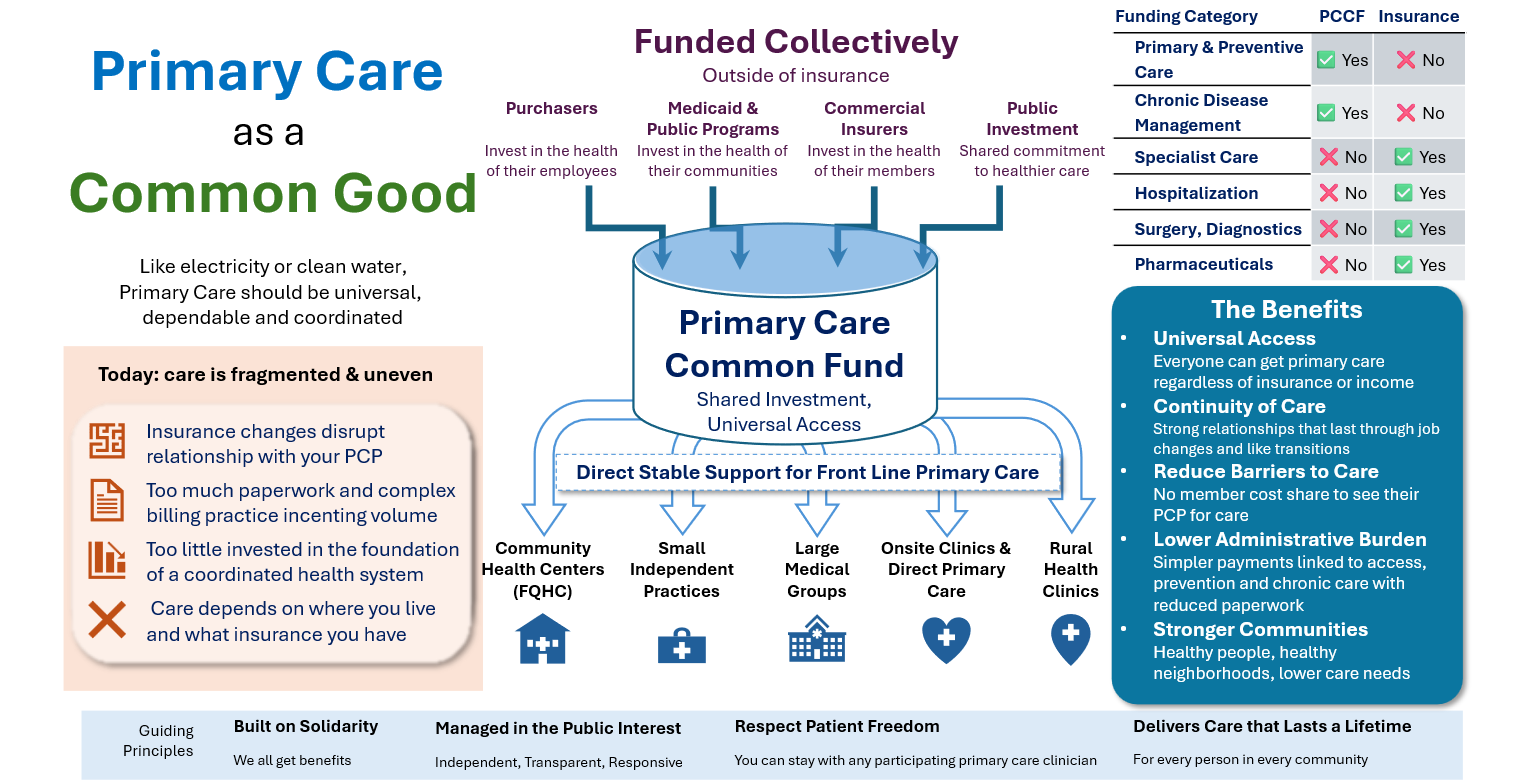
Primary care should be treated like a common good: universally available, dependable across life changes, publicly coordinated, and funded through a shared Common Fund that sits outside insurance claims payment.
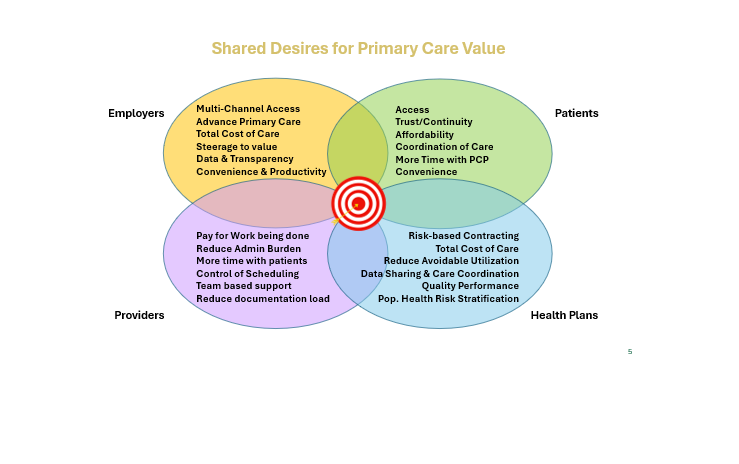
Despite decades of evidence on its value, one-third of individuals in the US do not functionally have a primary care clinician (PCC). Patients, payors, and employers want the same things from primary care (Graphic 1): timely access, continuity, affordability, and quality. Yet today’s financing ties access to insurance status, disrupts clinician relationships when coverage changes, and buries care in billing complexity.
We collectively fund roads, water, and fire departments because they are predictable services used by all. Why not primary care? Insurance is designed for rare, episodic events, not continuous care. We could carve primary care out of insurance and finance it through a public-private Primary Care Common Fund (PCCF), treating access as a public good. Over 20 states are already exploring ways to fund and set growth targets for primary care. It is time to move from admiring the issue to taking action.
The State of Washington, through the Office of the Insurance Commissioner, is exploring the concept of primary care as a common good, a universal primary care initiative. We applaud Commissioner Kruderer’s leadership to embark on such a necessary effort and we offer our vision for the future of primary care to inform and support her work.
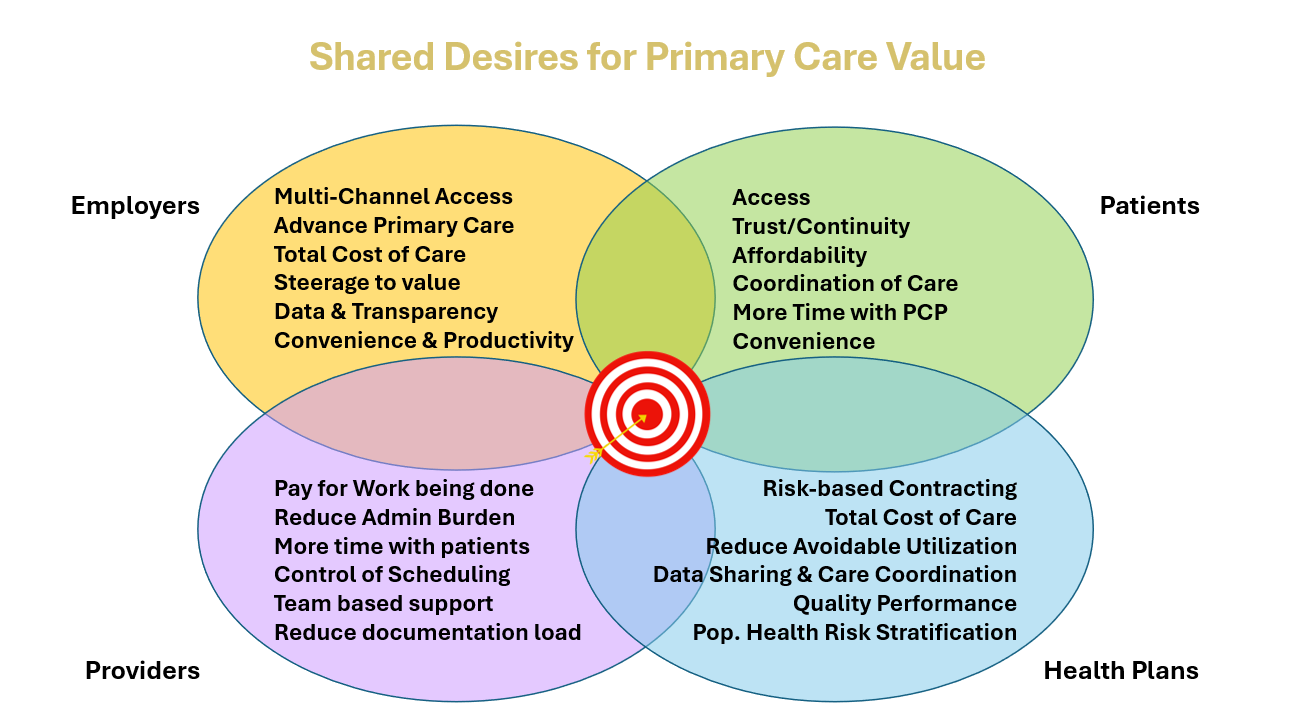
| Service Category | Funded by PCCF | Funded by Insurance |
| Primary & Preventive Care | ✅ Yes | ❌ No |
| Chronic Disease Management | ✅ Yes | ❌ No |
| Specialist Care | ❌ No | ✅ Yes |
| Hospitalization | ❌ No | ✅ Yes |
| Surgery, Diagnostics | ❌ No | ✅ Yes |
| Pharmaceuticals | ❌ No | ✅ Yes |
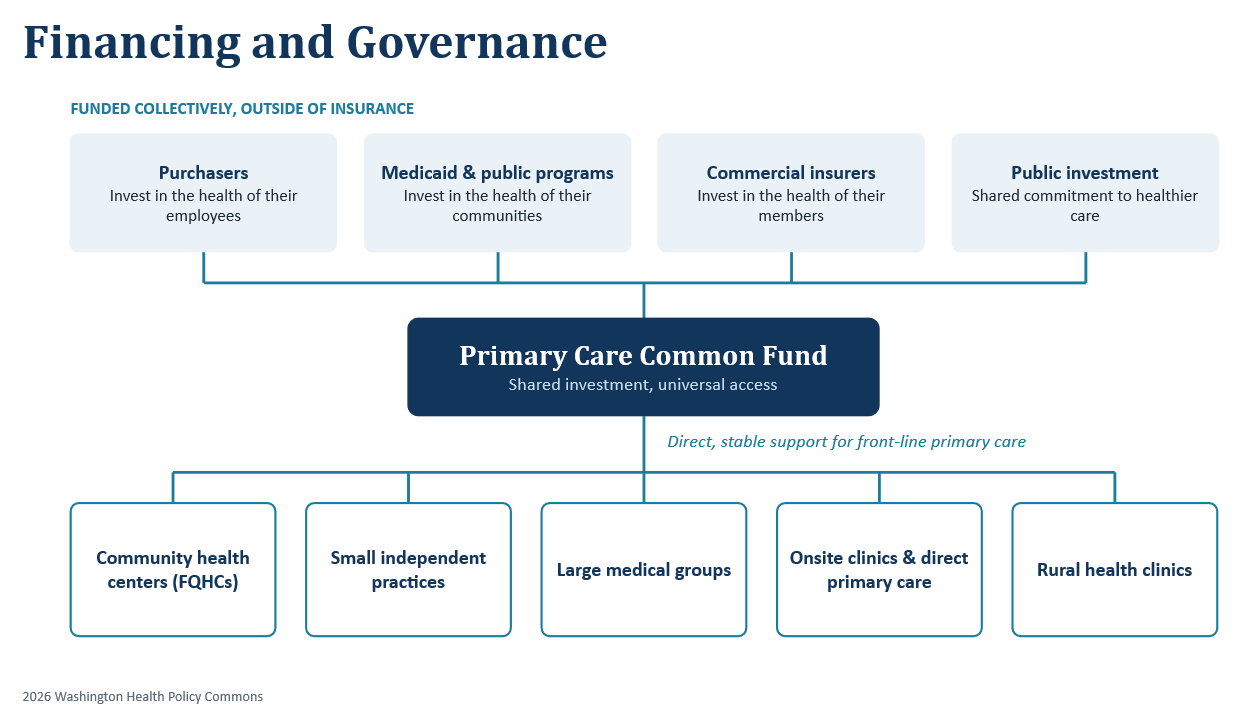
States control Medicaid, state employee coverage, and often an ACA marketplace, roughly 35% or more of the typical market. They could also assess fees on fully insured commercial plans and, with careful legal design, self-insured ERISA plans. Uninsured persons could participate on a sliding scale of income. Together, these sources cover most non-Medicare residents, and a state would pursue a Medicare waiver. Pooled funding means every member can choose a PCC who stays with them through job or insurance changes (Graphic 2).
An independent board of patients, doctors, employers, and community leaders would run the fund transparently, publishing results, and directing money to the different delivery models (Graphic 3). The model would be piloted in urban, suburban, and rural communities before scaling statewide.
Continuity with a primary care clinician leads to better care, and Medicare spending can fall by more than 14%. The PCCF, with improved primary care access, can accrue benefits beyond the consumer:
Will funding primary care prospectively bend overall cost trends? Assuring a patient has a PCC is not enough; investment must be paired with accountability for access, prevention, chronic care, total cost of care, and referrals to high quality specialists. Will it strengthen the clinician pipeline? Past interventions that offer reasonable panels, autonomy, and fair pay suggest yes.
The data, research, and international experience say treating primary care as a common good would make a meaningful difference.
Piecemeal changes have proven futile. It is time to think bigger.
References: