
A recent presentation by Dept. of Insurance Director Dean Cameron showed how Idahoans are insured by line of business.
It created an interesting story about Idaho’s economy that might get overlooked, and that is this: for as much growth as has occurred in Idaho in recent years, that growth is not happening in small to medium sized businesses.
Hollowing out the small to medium sized businesses in an economy as a percentage of the whole creates a series of economic challenges, and ultimately undermines small town and broader economic resiliency.
Here are the enrollment numbers Cameron shared.
In the first slide, we see the total number of insured Idahoans from the private market. Many of these lines of business are regulated to some degree by the Dept. of Insurance, but some get more regulatory attention than others.
For example, the Individual market and Group markets are squarely in the purview of DOI regulatory scope for operations, as are short-term, limited duration insurance (STLDI) plans. Most of the other types of plans are licensed by the DOI but not actively regulated by the state to the same degree as the individual and group markets. Self-funded lives are regulated under the federal ERISA statute.
The same is true for the plans in the “public” space on a second slide. These plans are regulated by the federal government or by the Dept. of Health and Welfare. A significant amount of Medicaid is operated by DHW itself.

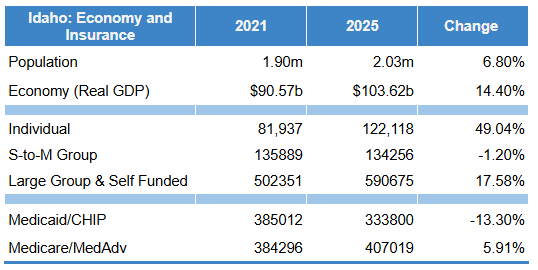
According to the Federal Reserve, Idaho’s economy in real terms grew 14.4% during this same time. Its population increased from 1.90m to 2.03m, an increase of 6.80%.
If we want to compare this growth to the changes in the lines of business in insurance coverage, we can learn more by aggregating certain lines of business. For example, we can aggregate Medicare and Medicare Advantage for a sense of the growth in the number of seniors in the state.
We can put together Medicaid and CHIP as an expression of lower income individuals and families.
We can merge the self-funded coverage and the large group market as an expression of the population covered by the large employers in Idaho’s economy. We can leave the small and medium group markets as everything else — those small to mid-sized businesses too small for the large group market or the full risk of self-funding.
Here are a few takeaways that don’t really come as a surprise.
There are surprises in here, as well, however, and that may be a harbinger of challenges to come.
The individual market is a little more volatile, in general. So, a swing like this isn’t on its own out of the ordinary. But, it’s a huge shift while enhanced premium tax credits have also expired (end of 2025), effectively doubling the out of pocket amounts individuals are paying for premiums. That said, this growth in the individual market is probably a reflection of the economy improving overall.
More important, I think is that while the Idaho economy is growing, smaller businesses are not enjoying comparable success.
When you see an economy concentrating its jobs in larger companies, you tend to see a significant change in the structure of the economy. It represents part of the shift from a “stakeholder” economy to a “shareholder” economy. What this means is that as small businesses decline as a share of the economy, there are fewer business owners who stay connected to their community as “stakeholders.” Think fewer family-owned farms or locally-owned grocery stores and more jobs in corporate enterprises.
People don’t move from their small towns if they own their main street business in said small town. You’ve got a “stake” in the community through good times and bad.
But, if your income comes from a corporate job, you can leave and take your money with you at any time. You can move to the nicer neighborhood, with the nicer schools, and leave the struggling community behind. The nonprofit participation, community volunteerism and charitable giving all leave as well, in addition to the downward pressure on housing prices.
This exacerbates inequality, makes economic growth harder in smaller towns, and puts all of the disposable income “eggs” in the baskets associated with the larger corporate jobs: neighborhoods, schools, housing, etc.
In Oregon, as jobs concentrated among higher profile corporate names like Nike and Intel, smaller towns became a little less resilient. When the Great Recession hit, that lack of resiliency was put to the test. Jumping ahead 15 years or so to 2026, and the small group market in Oregon has still not replaced the beneficiary count from the pre-Great Recession period. In other words, Oregon has yet to replace the small business jobs that went away 15 years ago.
For many reasons, Oregon is now one of the weaker economic areas of activity in the United States. Losing its small businesses is a foundational part of that story.
Or, look at Washington State. This was an economy driven by the tech sector of Puget Sound. Two of the five most important companies in the history of the world are based there: Microsoft and Amazon, along with homegrown Fortune 500 companies like Expedia, Costco, Starbucks, Weyerhaeuser and other significant names.
This growth in Washington State over the last 30 years has concentrated jobs among large employers. Small businesses have not kept pace with the once-in-a-generation pace of growth in the tech sector. The labor cost increases driven by high income corporate jobs makes finding skilled labor for smaller businesses almost cost prohibitive.
Now, as fiscal policy there is driving larger employers to look beyond Washington State, the economy has lost many of the smaller business employers that might hope to benefit from a loosening labor market. It all results in some of the highest unemployment, lowest economic growth, and greatest interest in leaving the state of any metro area in the country.
So, what does this all mean? What am I getting at here in this long-winded piece?
While large corporate success stories are the key drivers of above average economic growth for a region, it’s the small to medium businesses, the stakeholder businesses that keep main street-focused communities, our small towns, healthy. They are also the key to broader economic resilience.
And, if this DOI data can be used as a lens for understanding where Idaho jobs are these days, the direction may be a mixed bag for Idaho’s economy moving forward.