HR 1, or the One Big Beautiful Bill Act, is primarily a bill full of technical changes to Medicaid financing.
Because many of those changes are directed at states with the most creative financing mechanisms for Medicaid, some observers have noted these tend to fall a little harder on blue states.
These “creative financing mechanisms” are often in states with managed care, and even more prominently in states with 1115 waivers. Washington, Oregon and California are all such states, all blue states, each of which is hard at work trying to modify their systems to accommodate their changes.
This isn’t categorically true, of course. A red state like Texas has a lot of creative financing through its 1115 waiver. A red state like Idaho is facing cuts to provider taxes and rates that differentiate across inpatient and outpatient settings, a challenge that may not impact any other state like it does Idaho.
All states, however, must now implement the work requirements for Medicaid in HR 1. Effective January 1, 2027, “community engagement” requirements must be met for expansion population Medicaid beneficiaries. According to the bill, those requirements can be met a number of ways, including volunteering. But the standard in the bill is that this employment, or volunteerism, must total 80 hours per month.
In states with the federal minimum wage of $7.25 per hour, those 80 hours would equal $580 in income per month.
This summer, CMS put out a rule to update and clarify the work requirement, or community engagement, regulations.
Under the rule, affected Medicaid applicants and enrollees (referred to as “applicable individuals”) will be required to demonstrate 80 hours per month of qualifying activities, such as employment, participation in certain work programs, or community service, or be enrolled in an educational program at least half time. Individuals may combine activities to meet the 80-hour requirement, or meet it by earning at least 80 times the Federal hourly minimum wage ($580 per month in 2026).
This alternative pathway of earning $580 per month to stay eligible for Medicaid actually works to the benefit of blue states.
In King County, Washington, the minimum wage in 2027 will be $21.57. That means a minimum wage worker there will only need to work 27 hours to earn benefits, while the minimum wage worker in Boise will need to work the full 80 hours.
In Los Angeles, a hotel worker at minimum wage makes $25 per hour. That means the worker needs just over 23 hours to be eligible. In Portland, the minimum wage is $16.80, or 34.5 hours to hit the eligibility standard.
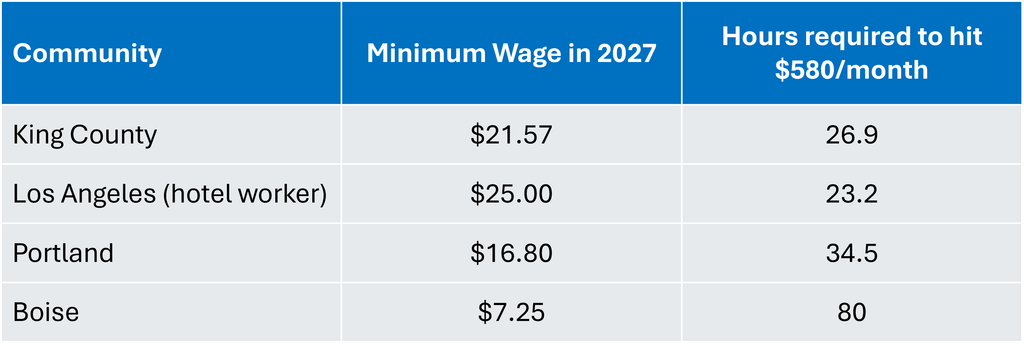
So, in the rule-making this summer, blue regions that have adopted a higher minimum wage have benefited. They no longer have to have 80 hours of work to maintain their Medicaid benefits. They can instead maintain their benefits by hitting the $580 of income per month standard.
And, with blue state minimum wages, they’re going to hit that threshold much more quickly than their red state neighbors.